
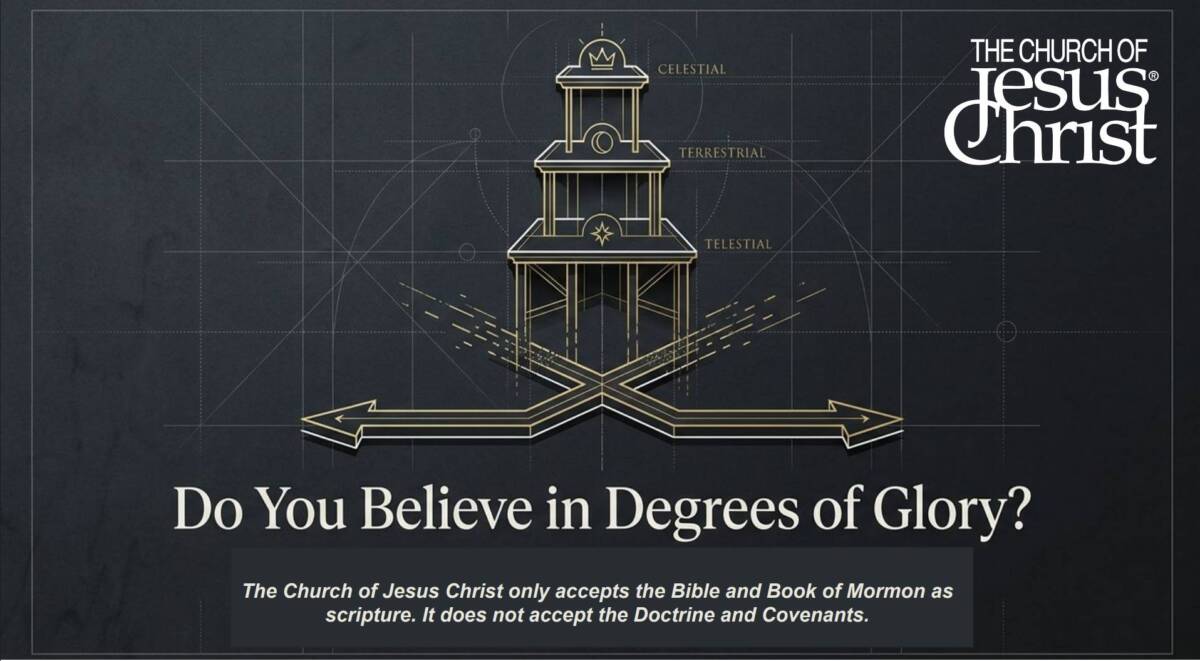
The Church of Jesus Christ does not believe in three degrees of glory after this life. The three degrees of glory is a teaching that many in the restoration movement accept — a vision of the afterlife where God’s mercy extends broadly and almost everyone inherits some degree of glory. We understand that appeal, and we respect the genuine compassion behind it. However, we want to explore whether this framework comes from scripture — or whether God’s actual promises are both simpler and more profound than we might expect.
For those unfamiliar with three degrees of glory teaching, nearly everyone goes somewhere good. The celestial kingdom is for the most faithful. The terrestrial kingdom is for the honorable but uncommitted. The telestial kingdom — while far from God’s presence — is still described as surpassing anything on earth. Only the most extreme rebels — the sons of perdition — are truly lost. It feels generous and quite merciful.
The question is whether God actually created it — or whether it was created through misinterpretation.
The three degrees of glory are taught exclusively in Doctrine and Covenants, which The Church of Jesus Christ does not uphold as scripture. Specifically in Section 76, the vision Joseph Smith and Sidney Rigdon received in 1832. The detailed celestial-terrestrial-telestial framework as interpreted for afterlife does not appear in the Bible. It does not appear in the Book of Mormon. It is entirely absent from the two scriptures The Church of Jesus Christ accepts as the word of God. This article examines what scripture actually teaches about the afterlife — and why the answer, though simpler than the three-kingdom system, is not less hopeful.
1. Where the Three Degrees Come From
The doctrine of three degrees of glory rests entirely on a specific interpretation of D&C 76. In this vision, the description of seeing three kingdoms: the celestial (compared to the glory of the sun), the terrestrial (compared to the moon), and the telestial (compared to the stars) is offered. Each kingdom was assigned different populations — the celestial for the valiant, the terrestrial for the honorable but not valiant, the telestial for the wicked who eventually receive a measure of glory after suffering.
This vision became the organizing center of afterlife theology for many divergent paths in the restoration. Once the three kingdoms were accepted as universally representing the afterlife, an entire revised system of the plan of salvation logically followed. If there are three kingdoms, and if the celestial kingdom requires specific ordinances — baptism, confirmation, endowment, sealing — then the temple becomes the gateway to the highest salvation. If the telestial kingdom still receives a measure of glory, then hell is effectively eliminated for all but the worst offenders. And if the terrestrial kingdom exists as a permanent middle ground, then there is less urgency about repentance — because even the uncommitted inherit something while negating the afterlife as described in the Bible and Book of Mormon.
This whole architecture — temple ordinances, proxy baptism, celestial marriage, degrees of exaltation — hinges on accepting a specific interpretation of D&C 76 as the framework for understanding eternity. Remove the three kingdoms, and the entire system that depends on them becomes unnecessary.
This is why the question matters. It is not a minor point. It is the foundation on which Latter-day temple systems, the proxy baptism system, and the exaltation framework are built.
2. What the Book of Mormon Actually Teaches
The Book of Mormon speaks of the afterlife in binary terms — not three kingdoms, but two destinies for the state of the soul immediately after this life.
Alma describes two paths after death: “The spirits of those who are righteous are received into a state of happiness, which is called paradise” (Alma 40:12). And: “The spirits of the wicked… shall be cast out into outer darkness; there shall be weeping, and wailing, and gnashing of teeth” (Alma 40:13). Paradise or outer darkness. Happiness or misery. The presence of God or separation from Him. There is no terrestrial middle ground. There is no telestial kingdom where the wicked eventually inherit glory.
Nephi prophesied two churches — not three: “Behold there are save two churches only; the one is the church of the Lamb of God, and the other is the church of the devil” (1 Nephi 14:10). Two categories. Two allegiances. The Book of Mormon consistently presents the human condition in binary terms: light or darkness, Christ or Satan, life or death, saved or lost.
The Book of Mormon’s description of judgment is equally binary. Alma teaches: “And then shall the righteous shine forth in the kingdom of God. But behold, an awful death cometh upon the wicked;… for they are unclean, and no unclean thing can inherit the kingdom of God; but they are cast out” (Alma 40:25–26). The righteous inherit the kingdom. The wicked are cast out. There is no third category.
Jacob’s great sermon on the Atonement describes the same two outcomes: “O how great the plan of our God!… the paradise of God must deliver up the spirits of the righteous, and the grave deliver up the body of the righteous” (2 Nephi 9:13). And for the wicked: “The devil and his angels… and they who belong to his kingdom must be cast off” (2 Nephi 9:16). Delivered up or cast off. The kingdom of God or the kingdom of the devil. Two destinations.
Nowhere in the entire Book of Mormon (or Bible) is there a teaching of three kingdoms. Nowhere is there a “terrestrial” middle ground. Nowhere is there a “telestial” glory for the wicked. The Book of Mormon, from beginning to end, presents the afterlife as a choice between two paths — and it treats that choice with the utmost seriousness.
3. What Paul Really Said About Sun, Moon, and Stars
The passage most frequently cited among other groups to support the three degrees of glory in the afterlife is 1 Corinthians 15:40–42. In this interpretation from other traditions, Paul’s reference to the glory of the sun, moon, and stars is read as a direct map of three kingdoms: celestial (sun), terrestrial (moon), telestial (stars). D&C 76 explicitly builds on this reading.
But Paul is not constructing a kingdom system. He is answering a question about the nature of the resurrected body — and his analogy serves an entirely different purpose.
The full passage: “There are also celestial bodies, and bodies terrestrial: but the glory of the celestial is one, and the glory of the terrestrial is another. There is one glory of the sun, and another glory of the moon, and another glory of the stars: for one star differeth from another star in glory. So also is the resurrection of the dead.” (1 Corinthians 15:40–42).
Paul’s argument in context is straightforward. The Corinthians are asking: “How are the dead raised up? and with what body do they come?” (1 Corinthians 15:35). Paul answers by pointing to the variety in creation. Just as there are different kinds of bodies — heavenly bodies and earthly bodies — and just as heavenly bodies themselves differ in brightness (the sun is brighter than the moon, which is brighter than the stars, and even individual stars differ from one another), so also will resurrected bodies differ. Paul is talking about the quality and character of the resurrected state — that each will differ while all will shine — not about three separate kingdoms where different populations are permanently assigned.
Paul’s conclusion confirms this: “It is sown in corruption; it is raised in incorruption:It is sown in dishonour; it is raised in glory: it is sown in weakness; it is raised in power“ (1 Corinthians 15:42–43). He is describing the triumph of the resurrection — not mapping out a three-tiered afterlife.
The word “telestial” does not appear in the Bible at all. It is not a biblical word. It appears only in D&C 76. When D&C 76 takes Paul’s analogy about resurrected bodies and converts it into a three-kingdom afterlife system, it is imposing a framework on Paul that Paul did not intend and his original audience would not have recognized.
4. What Jesus Meant by “Many Mansions”
Another passage frequently cited in support of the degrees of glory is John 14:2: “In my Father’s house are many mansions.”
This is sometimes read in restoration movement traditions as evidence that God’s house contains multiple distinct kingdoms — many mansions corresponding to different levels of glory. But read the passage in context, and it says something entirely different.
Jesus is preparing His disciples for His departure. They are troubled. He comforts them: “Let not your heart be troubled: ye believe in God, believe also in me. In my Father’s house are many mansions: if it were not so, I would have told you. I go to prepare a place for you. And if I go and prepare a place for you, I will come again, and receive you unto myself; that where I am, there ye may be also.” (John 14:1–3).
The promise is not about different kingdoms for different classes of people. The promise is about being with Jesus — in the Father’s house, where there is room for all of them. The many mansions are all in the same house — the Father’s house. And the point is not the diversity of the rooms but the intimacy of the fellowship: “that where I am, there ye may be also.”
Jesus is not describing a tiered reward system. He is assuring His friends that there is a place for them — with Him, in His Father’s presence, forever.
5. What Scripture Is Clear About: Two Outcomes
When the Bible and the Book of Mormon are surveyed as a whole — without the overlay of D&C 76 — a consistent pattern emerges. Scripture speaks of two outcomes, not three. Two resurrections. Two destinations. Two kinds of lives and two kinds of eternities.
Daniel: “Many of them that sleep in the dust of the earth shall awake, some to everlasting life, and some to shame and everlasting contempt” (Daniel 12:2). Everlasting life or everlasting contempt. Two outcomes.
Jesus: “All that are in the graves shall hear his voice, and shall come forth; they that have done good, unto the resurrection of life; and they that have done evil, unto the resurrection of damnation” (John 5:28–29). The resurrection of life or the resurrection of damnation. Two resurrections.
Jesus again, in the parable of the sheep and the goats: “These shall go away into everlasting punishment: but the righteous into life eternal” (Matthew 25:46). Everlasting punishment or eternal life. Two destinations. No middle category.
John in Revelation: “Whosoever was not found written in the book of life was cast into the lake of fire” (Revelation 20:15). The book of life or the lake of fire. Two outcomes. There is no telestial kingdom where the wicked inherit a measure of glory. There is God’s kingdom or there is not.
Alma in the Book of Mormon: “The righteous shall shine forth in the kingdom of God… but they are cast out, and consigned to partake of the fruits of their labors” (Alma 40:25–26). The kingdom of God or casting out. Two outcomes.
The consistency is striking. From Daniel through Jesus through Revelation through the Book of Mormon, the testimony is the same: there are two paths, two resurrections, two eternal destinies. The three-kingdom interpretation of the afterlife framework of D&C 76 is not a development of this teaching. It is a departure from it.
6. Why This Matters: What the Three-Kingdom System Costs
The three-kingdom system feels generous. Nearly everyone goes somewhere good—even the wicked inherit a telestial glory that surpasses anything on earth, leaving only the most extreme rebels, sons of perdition, truly lost. It sounds like a loving God’s design; however, it completely bypasses divine justice.
But this theological generosity comes at a steep cost. Alma addresses this tension directly: “For behold, justice exerciseth all his demands, and also mercy claimeth all which is her own; and thus, none but the truly penitent are saved. What, do ye suppose that mercy can rob justice? I say unto you, Nay; not one whit. If so, God would cease to be God.” (Alma 42:24–25)
It diminishes the urgency of repentance. If even the wicked receive a kingdom of glory, what is at stake in this life? Why repent now when a lesser-but-still-glorious kingdom awaits the unrepentant? Scripture teaches the opposite: “Now is the accepted time; behold, now is the day of salvation” (2 Corinthians 6:2). The urgency is real because the consequences are real. There are not three soft landings. There is life and there is death.
It diminishes the Atonement. In a three-kingdom afterlife system, the Atonement becomes primarily about placement — which kingdom you end up in, based on which ordinances you received and how faithfully you performed. But in the Bible and the Book of Mormon, the Atonement is about rescue. Without Christ, we are lost — not assigned to a lesser kingdom, but genuinely, permanently lost. Jacob warns: “If the flesh should rise no more our spirits must become subject to that angel who fell” (2 Nephi 9:8). The Atonement is not a sorting mechanism. It is the difference between life and death.
It effectively eliminates hell. Jesus taught clearly of a final separation — sheep and goats, heaven and hell (Matthew 25:31–46). John saw the lake of fire as the eternal destination of the unbelieving (Revelation 21:8). The three-kingdom system replaces this with a graduated reward system where nearly everyone receives glory. But scripture does not teach graduated glory for the wicked. It teaches separation from God — real, permanent, and terrible.
The Church of Jesus Christ does not claim to have a detailed map of eternity. We do not know everything about what lies beyond the grave – no one has this complete picture. But where scripture is clear, we hold to it firmly. And scripture is clear that there are two paths, not three or four — that the choice between Christ and the world is the choice between life and death — and that this choice matters infinitely, urgently, and permanently.
We do not need a three-tier system to assure us that God is fair. We only need to know that God is God — just, merciful, and the Judge of all the earth who will do right (Genesis 18:25).
Conclusion & Invitation
The Church of Jesus Christ accepts only the Bible and the Book of Mormon as scripture and does not accept the Doctrine and Covenants as scripture. Accordingly, the focus here is not on refuting the vision and experience recorded in D&C 76 itself. Rather, The church rejects the doctrine derived from it: specifically the interpretation of multiple degrees of glory (celestial-terrestrial-telestial) after Judgment Day because it is inconsistent with the Bible and the Book of Mormon.
If what you have read here has raised questions, we encourage you to take them to God in prayer. Read the scriptures cited in this article for yourself. Search the scriptures daily to see whether these things are so (Acts 17:11). The Holy Spirit is faithful and will guide you into truth.
What the Book of Mormon teaches. Two afterlife destinies — paradise or outer darkness. No three-kingdom system. No terrestrial middle ground. No telestial glory for the wicked.
What Paul really said. The sun-moon-stars passage is about the nature of resurrected bodies, not about three kingdoms. The word “telestial” does not appear in the Bible.
What Jesus meant. The “many mansions” are all in the Father’s house — assurance of fellowship with Christ, not a tiered reward system.
What scripture is clear about. Two outcomes — life or death, God’s kingdom or separation from it. Daniel, Jesus, John, and Alma all testify to the same binary.
Why it matters. The three-kingdom system diminishes urgency and reduces the Atonement to a sorting mechanism.
The Church of Jesus Christ believes in a real judgment, real consequences for sin, and real reward for faithfulness. But we believe these things according to what scripture clearly teaches — not according to a modern vision that reframes everything that came before. God is just. God is merciful. And Christ stands at the gate of judgment for Himself.
“For God so loved the world, that he gave his only begotten Son, that whosoever believeth in him should not perish, but have everlasting life.” — John 3:16
More Resources
Can’t see the document? Click here to download or view the PDF.